Game theory - Wikipedia
http://en.wikipedia.org/wiki/Game_theory
Cournot competition - Wikipedia
http://en.wikipedia.org/wiki/Cournot_equilibrium
========================================================================
Nash equilibrium - Wikipedia
http://en.wikipedia.org/wiki/Nash_equilibrium
Nash equilibrium
From Wikipedia, the free encyclopedia
In
game theory, the
Nash equilibrium (named after
John Forbes Nash, who proposed it) is a
solution concept of a game involving two or more players, in which each player is assumed to know the equilibrium strategies of the other players, and no player has anything to gain by changing only his own strategy unilaterally.
[1]:14 If each player has chosen a strategy and no player can benefit by changing his or her strategy while the other players keep theirs unchanged, then the current set of strategy choices and the corresponding payoffs constitute a Nash equilibrium.
Stated simply, Amy and Phil are in Nash equilibrium if Amy is making the best decision she can, taking into account Phil's decision, and Phil is making the best decision he can, taking into account Amy's decision. Likewise, a group of players are in Nash equilibrium if each one is making the best decision that he or she can, taking into account the decisions of the others.
Applications
Game theorists use the Nash equilibrium concept to analyze the outcome of the
strategic interaction of several
decision makers. In other words, it provides a way of predicting what will happen if several people or several institutions are making decisions at the same time, and if the outcome depends on the decisions of the others. The simple insight underlying John Nash's idea is that we cannot predict the result of the choices of multiple decision makers if we analyze those decisions in isolation. Instead, we must ask what each player would do,
taking into account the decision-making of the others.
Nash equilibrium has been used to analyze hostile situations like
war and
arms races[2] (see
Prisoner's dilemma), and also how conflict may be mitigated by repeated interaction (see
Tit-for-tat). It has also been used to study to what extent people with different preferences can cooperate (see
Battle of the sexes), and whether they will take risks to achieve a cooperative outcome (see
Stag hunt). It has been used to study the adoption of
technical standards[citation needed], and also the occurrence of
bank runs and
currency crises (see
Coordination game). Other applications include traffic flow (see
Wardrop's principle), how to organize auctions (see
auction theory), the outcome of efforts exerted by multiple parties in the education process,
[3] and even penalty kicks in
soccer (see
Matching pennies).
[4]
History
A version of the Nash equilibrium concept was first used by
Antoine Augustin Cournot in his theory of oligopoly (1838). In Cournot's theory, firms choose how much output to produce to maximize their own profit. However, the best output for one firm depends on the outputs of others. A
Cournot equilibrium occurs when each firm's output maximizes its profits given the output of the other firms, which is a
pure strategy Nash Equilibrium.
The modern game-theoretic concept of Nash Equilibrium is instead defined in terms of
mixed strategies, where players choose a probability distribution over possible actions. The concept of the mixed strategy Nash Equilibrium was introduced by
John von Neumann and
Oskar Morgenstern in their 1944 book
The Theory of Games and Economic Behavior. However, their analysis was restricted to the special case of
zero-sum games. They showed that a mixed-strategy Nash Equilibrium will exist for any zero-sum game with a finite set of actions. The contribution of
John Forbes Nash in his 1951 article
Non-Cooperative Games was to define a mixed strategy Nash Equilibrium for any game with a finite set of actions and prove that at least one (mixed strategy) Nash Equilibrium must exist in such a game.
Since the development of the Nash equilibrium concept, game theorists have discovered that it makes misleading predictions (or fails to make a unique prediction) in certain circumstances. Therefore they have proposed many related
solution concepts (also called 'refinements' of Nash equilibrium) designed to overcome perceived flaws in the Nash concept. One particularly important issue is that some Nash equilibria may be based on threats that are not '
credible'. Therefore, in 1965
Reinhard Selten proposed
subgame perfect equilibrium as a refinement that eliminates equilibria which depend on
non-credible threats. Other extensions of the Nash equilibrium concept have addressed what happens if a game is
repeated, or what happens if a game is played in the
absence of perfect information. However, subsequent refinements and extensions of the Nash equilibrium concept share the main insight on which Nash's concept rests: all equilibrium concepts analyze what choices will be made when each player takes into account the decision-making of others.
Definitions
Informal definition
Informally, a set of strategies is a Nash equilibrium if no player can do better by unilaterally changing his or her strategy. To see what this means, imagine that each player is told the strategies of the others. Suppose then that each player asks himself or herself: "Knowing the strategies of the other players, and treating the strategies of the other players as set in stone, can I benefit by changing my strategy?"
If any player would answer "Yes", then that set of strategies is not a Nash equilibrium. But if every player prefers not to switch (or is indifferent between switching and not) then the set of strategies is a Nash equilibrium. Thus, each strategy in a Nash equilibrium is a
best response to all other strategies in that equilibrium.
[5]
The Nash equilibrium may sometimes appear non-rational in a third-person perspective. This is because it may happen that a Nash equilibrium is not
Pareto optimal.
The Nash equilibrium may also have non-rational consequences in sequential games because players may "threaten" each other with non-rational moves. For such games the
subgame perfect Nash equilibrium may be more meaningful as a tool of analysis.
Formal definition
Let
(S, f) be a game with
n players, where
Si is the strategy set for player
i,
S=S1 × S2 ... × Sn is the set of
strategy profiles and
f=(f1(x), ..., fn(x)) is the payoff function for
x  S
S. Let
xi be a strategy profile of player
i and
x-i be a strategy profile of all players except for player
i. When each player
i {1, ..., n} chooses strategy
xi resulting in strategy profile
x = (x1, ..., xn) then player
i obtains payoff
fi(x). Note that the payoff depends on the strategy profile chosen, i.e., on the strategy chosen by player
i as well as the strategies chosen by all the other players. A strategy profile
x* S is a Nash equilibrium (NE) if no unilateral deviation in strategy by any single player is profitable for that player, that is

A game can have either a
pure-strategy or a
mixed Nash Equilibrium, (in the latter a pure strategy is chosen
stochastically with a fixed
frequency). Nash proved that if we allow
mixed strategies, then every game with a finite number of players in which each player can choose from finitely many pure strategies has at least one Nash equilibrium.
When the inequality above holds strictly (with

instead of

) for all players and all feasible alternative strategies, then the equilibrium is classified as a
strict Nash equilibrium. If instead, for some player, there is exact equality between

and some other strategy in the set

, then the equilibrium is classified as a
weak Nash equilibrium.
Examples
Coordination game
A sample coordination game showing relative payoff for player1 / player2 with each combination
| Player 2 adopts strategy A | Player 2 adopts strategy B |
|---|
| Player 1 adopts strategy A | 4 / 4 | 1 / 3 |
|---|
| Player 1 adopts strategy B | 3 / 1 | 2 / 2 |
|---|
The
coordination game is a classic (
symmetric) two player, two
strategy game, with an example
payoff matrix shown to the right. The players should thus coordinate, both adopting strategy A, to receive the highest payoff; i.e., 4. If both players chose strategy B though, there is still a Nash equilibrium. Although each player is awarded less than optimal payoff, neither player has incentive to change strategy due to a reduction in the immediate payoff (from 2 to 1).
A famous example of this type of game was called the
Stag hunt; in the game two players may choose to hunt a stag or a rabbit, the former providing more meat (4 utility units) than the latter (1 utility unit). The caveat is that the stag must be cooperatively hunted, so if one player attempts to hunt the stag, while the other hunts the rabbit, he will fail in hunting (0 utility units), whereas if they both hunt it they will split the payload (2, 2). The game hence exhibits two equilibria at (stag, stag) and (rabbit, rabbit) and hence the players' optimal strategy depend on their expectation on what the other player may do. If one hunter trusts that the other will hunt the stag, he should hunt the stag; however if he suspects that the other will hunt the rabbit, he should hunt the rabbit. This game was used as an analogy for social cooperation, since much of the benefit that people gain in society depends upon people cooperating and implicitly trusting one another to act in a manner corresponding with cooperation.
Another example of a coordination game is the setting where two technologies are available to two firms with compatible products, and they have to elect a strategy to become the market standard. If both firms agree on the chosen technology, high sales are expected for both firms. If the firms do not agree on the standard technology, few sales result. Both strategies are Nash equilibria of the game.
Driving on a road, and having to choose either to drive on the left or to drive on the right of the road, is also a coordination game. For example, with payoffs 100 meaning no crash and 0 meaning a crash, the coordination game can be defined with the following payoff matrix:
The driving game
| Drive on the Left | Drive on the Right |
|---|
| Drive on the Left | 100, 100 | 0, 0 |
|---|
| Drive on the Right | 0, 0 | 100, 100 |
|---|
In this case there are two pure strategy Nash equilibria, when both choose to either drive on the left or on the right. If we admit
mixed strategies (where a pure strategy is chosen at random, subject to some fixed probability), then there are three Nash equilibria for the same case: two we have seen from the pure-strategy form, where the probabilities are (0%,100%) for player one, (0%, 100%) for player two; and (100%, 0%) for player one, (100%, 0%) for player two respectively. We add another where the probabilities for each player is (50%, 50%).
Prisoner's dilemma
(note differences in the orientation of the payoff matrix)
Example PD payoff matrix
| Cooperate | Defect |
|---|
| Cooperate | 3, 3 | 0, 5 |
|---|
| Defect | 5, 0 | 1, 1 |
|---|
The Prisoner's Dilemma has the same payoff matrix as depicted for the Coordination Game, but now C > A > D > B. Because C > A and D > B, each player improves his situation by switching from strategy #1 to strategy #2, no matter what the other player decides. The Prisoner's Dilemma thus has a single Nash Equilibrium: both players choosing strategy #2 ("defect"). What has long made this an interesting case to study is the fact that D < A (i.e., "both defect" is globally inferior to "both cooperate"). That is, both players would be better off if they both chose the other strategy, but doing so is not an equilibrium.
Network traffic

Sample network graph. Values on edges are the travel time experienced by a 'car' travelling down that edge.

is the number of cars travelling via that edge.
An application of Nash equilibria is in determining the expected flow of traffic in a network. Consider the graph on the right. If we assume that there are
"cars" traveling from A to D, what is the expected distribution of traffic in the network?
This situation can be modeled as a "game" where every traveler has a choice of 3 strategies, where each strategy is a route from A to D (either

,

, or

). The "payoff" of each strategy is the travel time of each route. In the graph on the right, a car travelling via
experiences travel time of

, where
is the number of cars traveling on edge

. Thus, payoffs for any given strategy depend on the choices of the other players, as is usual. However, the goal in this case is to minimize travel time, not maximize it. Equilibrium will occur when the time on all paths is exactly the same. When that happens, no single driver has any incentive to switch routes, since it can only add to his/her travel time. For the graph on the right, if, for example, 100 cars are travelling from A to D, then equilibrium will occur when 25 drivers travel via
, 50 via
, and 25 via
. Every driver now has a total travel time of 3.75.
Notice that this distribution is not, actually, socially optimal. If the 100 cars agreed that 50 travel via
and the other 50 through
, then travel time for any single car would actually be 3.5 which is less than 3.75. This is also the Nash equilibrium if the path between B and C is removed, which means that adding an additional possible route can decrease the efficiency of the system, a phenomenon known as
Braess's Paradox.
Competition game
A competition game
| Player 2 chooses '0' | Player 2 chooses '1' | Player 2 chooses '2' | Player 2 chooses '3' |
|---|
| Player 1 chooses '0' | 0, 0 | 2, -2 | 2, -2 | 2, -2 |
|---|
| Player 1 chooses '1' | -2, 2 | 1, 1 | 3, -1 | 3, -1 |
|---|
| Player 1 chooses '2' | -2, 2 | -1, 3 | 2, 2 | 4, 0 |
|---|
| Player 1 chooses '3' | -2, 2 | -1, 3 | 0, 4 | 3, 3 |
|---|
This can be illustrated by a two-player game in which both players simultaneously choose an integer from 0 to 3 and they both win the smaller of the two numbers in points. In addition, if one player chooses a larger number than the other, then he/she has to give up two points to the other.
This game has a unique pure-strategy Nash equilibrium: both players choosing 0 (highlighted in light red). Any other choice of strategies can be improved if one of the players lowers his number to one less than the other player's number. In the table to the right, for example, when starting at the green square it is in player 1's interest to move to the purple square by choosing a smaller number, and it is in player 2's interest to move to the blue square by choosing a smaller number. If the game is modified so that the two players win the named amount if they both choose the same number, and otherwise win nothing, then there are 4 Nash equilibria (0,0...1,1...2,2...and 3,3).
Nash equilibria in a payoff matrix
There is an easy numerical way to identify Nash equilibria on a payoff matrix. It is especially helpful in two-person games where players have more than two strategies. In this case formal analysis may become too long. This rule does not apply to the case where mixed (stochastic) strategies are of interest. The rule goes as follows: if the first payoff number, in the duplet of the cell, is the maximum of the column of the cell and if the second number is the maximum of the row of the cell - then the cell represents a Nash equilibrium.
A Payoff Matrix - Nash Equilibria in bold
| Option A | Option B | Option C |
|---|
| Option A | 0, 0 | 25, 40 | 5, 10 |
|---|
| Option B | 40, 25 | 0, 0 | 5, 15 |
|---|
| Option C | 10, 5 | 15, 5 | 10, 10 |
|---|
We can apply this rule to a 3×3 matrix:
Using the rule, we can very quickly (much faster than with formal analysis) see that the Nash Equilibria cells are (B,A), (A,B), and (C,C). Indeed, for cell (B,A) 40 is the maximum of the first column and 25 is the maximum of the second row. For (A,B) 25 is the maximum of the second column and 40 is the maximum of the first row. Same for cell (C,C). For other cells, either one or both of the duplet members are not the maximum of the corresponding rows and columns.
This said, the actual mechanics of finding equilibrium cells is obvious: find the maximum of a column and check if the second member of the pair is the maximum of the row. If these conditions are met, the cell represents a Nash Equilibrium. Check all columns this way to find all NE cells. An N×N matrix may have between 0 and N×N
pure strategy Nash equilibria.
Stability
The concept of
stability, useful in the analysis of many kinds of equilibria, can also be applied to Nash equilibria.
A Nash equilibrium for a mixed strategy game is stable if a small change (specifically, an infinitesimal change) in probabilities for one player leads to a situation where two conditions hold:
- the player who did not change has no better strategy in the new circumstance
- the player who did change is now playing with a strictly worse strategy.
If these cases are both met, then a player with the small change in his mixed-strategy will return immediately to the Nash equilibrium. The equilibrium is said to be stable. If condition one does not hold then the equilibrium is unstable. If only condition one holds then there are likely to be an infinite number of optimal strategies for the player who changed.
John Nash showed that the latter situation could not arise in a range of well-defined games.
In the "driving game" example above there are both stable and unstable equilibria. The equilibria involving mixed-strategies with 100% probabilities are stable. If either player changes his probabilities slightly, they will be both at a disadvantage, and his opponent will have no reason to change his strategy in turn. The (50%,50%) equilibrium is unstable. If either player changes his probabilities, then the other player immediately has a better strategy at either (0%, 100%) or (100%, 0%).
Stability is crucial in practical applications of Nash equilibria, since the mixed-strategy of each player is not perfectly known, but has to be inferred from statistical distribution of his actions in the game. In this case unstable equilibria are very unlikely to arise in practice, since any minute change in the proportions of each strategy seen will lead to a change in strategy and the breakdown of the equilibrium.
The Nash equilibrium defines stability only in terms of unilateral deviations. In cooperative games such a concept is not convincing enough.
Strong Nash equilibrium allows for deviations by every conceivable coalition.
[6] Formally, a
Strong Nash equilibrium is a Nash equilibrium in which no coalition, taking the actions of its complements as given, can cooperatively deviate in a way that benefits all of its members.
[7] However, the Strong Nash concept is sometimes perceived as too "strong" in that the environment allows for unlimited private communication. In fact, Strong Nash equilibrium has to be
Pareto efficient. As a result of these requirements, Strong Nash is too rare to be useful in many branches of game theory. However, in games such as elections with many more players than possible outcomes, it can be more common than a stable equilibrium.
A refined Nash equilibrium known as
coalition-proof Nash equilibrium (CPNE)
[6] occurs when players cannot do better even if they are allowed to communicate and make "self-enforcing" agreement to deviate. Every correlated strategy supported by
iterated strict dominance and on the
Pareto frontier is a CPNE.
[8] Further, it is possible for a game to have a Nash equilibrium that is resilient against coalitions less than a specified size, k. CPNE is related to the
theory of the core.
Finally in the eighties, building with great depth on such ideas
Mertens-stable equilibria were introduced as a
solution concept.
Mertens stable equilibria satisfy both
forward induction and
backward induction. In a
Game theory context
stable equilibria now usually refer to
Mertens stable equilibria.
Occurrence
If a game has a
unique Nash equilibrium and is played among players under certain conditions, then the NE strategy set will be adopted. Sufficient conditions to guarantee that the Nash equilibrium is played are:
- The players all will do their utmost to maximize their expected payoff as described by the game.
- The players are flawless in execution.
- The players have sufficient intelligence to deduce the solution.
- The players know the planned equilibrium strategy of all of the other players.
- The players believe that a deviation in their own strategy will not cause deviations by any other players.
- There is common knowledge that all players meet these conditions, including this one. So, not only must each player know the other players meet the conditions, but also they must know that they all know that they meet them, and know that they know that they know that they meet them, and so on.
Where the conditions are not met
Examples of
game theory problems in which these conditions are not met:
- The first condition is not met if the game does not correctly describe the quantities a player wishes to maximize. In this case there is no particular reason for that player to adopt an equilibrium strategy. For instance, the prisoner’s dilemma is not a dilemma if either player is happy to be jailed indefinitely.
- Intentional or accidental imperfection in execution. For example, a computer capable of flawless logical play facing a second flawless computer will result in equilibrium. Introduction of imperfection will lead to its disruption either through loss to the player who makes the mistake, or through negation of the common knowledge criterion leading to possible victory for the player. (An example would be a player suddenly putting the car into reverse in the game of chicken, ensuring a no-loss no-win scenario).
- In many cases, the third condition is not met because, even though the equilibrium must exist, it is unknown due to the complexity of the game, for instance in Chinese chess.[9] Or, if known, it may not be known to all players, as when playing tic-tac-toe with a small child who desperately wants to win (meeting the other criteria).
- The criterion of common knowledge may not be met even if all players do, in fact, meet all the other criteria. Players wrongly distrusting each other's rationality may adopt counter-strategies to expected irrational play on their opponents’ behalf. This is a major consideration in “Chicken” or an arms race, for example.
Where the conditions are met
Due to the limited conditions in which NE can actually be observed, they are rarely treated as a guide to day-to-day behaviour, or observed in practice in human negotiations. However, as a theoretical concept in
economics and
evolutionary biology, the NE has explanatory power. The payoff in economics is utility (or sometimes money), and in evolutionary biology gene transmission, both are the fundamental bottom line of survival. Researchers who apply games theory in these fields claim that strategies failing to maximize these for whatever reason will be competed out of the market or environment, which are ascribed the ability to test all strategies. This conclusion is drawn from the "
stability" theory above. In these situations the assumption that the strategy observed is actually a NE has often been borne out by research
[citation needed].
[verification needed]
NE and non-credible threats
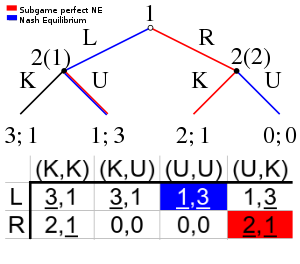
Extensive and Normal form illustrations that show the difference between SPNE and other NE. The blue equilibrium is not subgame perfect because player two makes a non-credible threat at 2(2) to be unkind (U).
The Nash equilibrium is a superset of the subgame perfect Nash equilibrium. The subgame perfect equilibrium in addition to the Nash Equilibrium requires that the strategy also is a Nash equilibrium in every subgame of that game. This eliminates all
non-credible threats, that is, strategies that contain non-rational moves in order to make the counter-player change his strategy.
The image to the right shows a simple sequential game that illustrates the issue with subgame imperfect Nash equilibria. In this game player one chooses left(L) or right(R), which is followed by player two being called upon to be kind (K) or unkind (U) to player one, However, player two only stands to gain from being unkind if player one goes left. If player one goes right the rational player two would de facto be kind to him in that subgame. However, The non-credible threat of being unkind at 2(2) is still part of the blue (L, (U,U)) Nash equilibrium. Therefore, if rational behavior can be expected by both parties the subgame perfect Nash equilibrium may be a more meaningful solution concept when such
dynamic inconsistencies arise.
Proof of existence
Nash's original proof (in his thesis) used Brouwer's fixed point theorem (e.g., see below for a variant). We give a simpler proof via the
Kakutani fixed point theorem, following Nash's 1950 paper (he credits
David Gale with the observation that such a simplification is possible).
To prove the existence of a Nash Equilibrium, let

be the best response of player i to the strategies of all other players.

Here,

, where

, is a mixed strategy profile in the set of all mixed strategies and

is the payoff function for player i. Define a set-valued function

such that

. The existence of a Nash Equilibrium is equivalent to

having a fixed point.
Kakutani's fixed point theorem guarantees the existence of a fixed point if the following four conditions are satisfied.
 is compact, convex, and nonempty.
 is nonempty.
- is convex.
- is upper hemicontinuous
Condition 1. is satisfied from the fact that
is a simplex and thus compact. Convexity follows from players' ability to mix strategies.
is nonempty as long as players have strategies.
Condition 2. is satisfied because players maximize expected payoffs which is continuous function over a compact set. The Weierstrass
Extreme Value Theorem guarantees that there is always a maximum value.
Condition 3. is satisfied as a result of mixed strategies. Suppose

, then

. i.e. if two strategies maximize payoffs, then a mix between the two strategies will yield the same payoff.
Condition 4. is satisfied by way of Berge's
maximum theorem. Because
is continuous and compact,

is upper hemicontinuous.
Therefore, there exists a fixed point in
and a Nash Equilibrium.
[10]
When Nash made this point to
John von Neumann in 1949, von Neumann famously dismissed it with the words, "That's trivial, you know. That's just a
fixed point theorem." (See Nasar, 1998, p. 94.)
We have a game

where

is the number of players and

is the action set for the players. All of the action sets

are finite. Let

denote the set of mixed strategies for the players. The finiteness of the
s ensures the compactness of

.
We can now define the gain functions. For a mixed strategy

, we let the gain for player

on action

be

The gain function represents the benefit a player gets by unilaterally changing his strategy. We now define

where

for

. We see that

We now use

to define

as follows. Let

for
. It is easy to see that each

is a valid mixed strategy in

. It is also easy to check that each
is a continuous function of

, and hence

is a continuous function. Now
is the cross product of a finite number of compact convex sets, and so we get that
is also compact and convex. Therefore we may apply the Brouwer fixed point theorem to
. So
has a fixed point in
, call it

.
I claim that
is a Nash Equilibrium in

. For this purpose, it suffices to show that

This simply states the each player gains no benefit by unilaterally changing his strategy which is exactly the necessary condition for being a Nash Equilibrium.
Now assume that the gains are not all zero. Therefore,

,

, and
such that

. Note then that

So let

. Also we shall denote

as the gain vector indexed by actions in
. Since

we clearly have that

. Therefore we see that


Since

we have that

is some positive scaling of the vector

. Now I claim that


. To see this, we first note that if
then this is true by definition of the gain function. Now assume that

. By our previous statements we have that

and so the left term is zero, giving us that the entire expression is

as needed.
So we finally have that




where the last inequality follows since
is a non-zero vector. But this is a clear contradiction, so all the gains must indeed be zero. Therefore
is a Nash Equilibrium for
as needed.
Computing Nash equilibria
If a player A has a
dominant strategy 
then there exists a Nash equilibrium in which A plays
. In the case of two players A and B, there exists a Nash equilibrium in which A plays
and B plays a
best response to
. If
is a strictly dominant strategy, A plays
in all Nash equilibria. If both A and B have strictly dominant strategies, there exists a unique Nash equilibrium in which each plays his strictly dominant strategy.
In games with mixed strategy Nash equilibria, the probability of a player choosing any particular strategy can be computed by assigning a variable to each strategy that represents a fixed probability for choosing that strategy. In order for a player to be willing to randomize, his expected payoff for each strategy should be the same. In addition, the sum of the probabilities for each strategy of a particular player should be 1. This creates a system of equations from which the probabilities of choosing each strategy can be derived.
[5]
Examples
Matching pennies
| Player B plays H | Player B plays T |
|---|
| Player A plays H | −1, +1 | +1, −1 |
|---|
| Player A plays T | +1, −1 | −1, +1 |
|---|
In the matching pennies game, player A loses a point to B if A and B play the same strategy and wins a point from B if they play different strategies. To compute the mixed strategy Nash equilibrium, assign A the probability p of playing H and (1−p) of playing T, and assign B the probability q of playing H and (1−q) of playing T.
- E[payoff for A playing H] = (−1)q + (+1)(1−q) = 1−2q
- E[payoff for A playing T] = (+1)q + (−1)(1−q) = 2q−1
- E[payoff for A playing H] = E[payoff for A playing T] ⇒ 1−2q = 2q−1 ⇒ q = 1/2
- E[payoff for B playing H] = (+1)p + (−1)(1−p) = 2p−1
- E[payoff for B playing T] = (−1)p + (+1)(1−p) = 1−2p
- E[payoff for B playing H] = E[payoff for B playing T] ⇒ 2p−1 = 1−2p ⇒ p = 1/2
Thus a mixed strategy Nash equilibrium in this game is for each player to randomly choose H or T with equal probability.
See also
- ^ Osborne, Martin J., and Ariel Rubinstein. A Course in Game Theory. Cambridge, MA: MIT, 1994. Print.
- ^ Schelling, Thomas, The Strategy of Conflict, copyright 1960, 1980, Harvard University Press, ISBN 0-674-84031-3.
- ^ G. De Fraja, T. Oliveira, L. Zanchi (2010), 'Must Try Harder: Evaluating the Role of Effort in Educational Attainment'. "The Review of Economis and Statistics" 92:3. pp. 577-597
- ^ P. Chiappori, S. Levitt, and T. Groseclose (2002), 'Testing Mixed-Strategy Equilibria When Players Are Heterogeneous: The Case of Penalty Kicks in Soccer'. American Economic Review 92, pp. 1138-51.
- ^ a b von Ahn, Luis. "Preliminaries of Game Theory". http://www.scienceoftheweb.org/15-396/lectures_f11/lecture09.pdf. Retrieved 2008-11-07.
- ^ a b B. D. Bernheim, B. Peleg, M. D. Whinston (1987), "Coalition-Proof Equilibria I. Concepts", Journal of Economic Theory 42 (1): 1–12, DOI:10.1016/0022-0531(87)90099-8.
- ^ R. Aumann, (1959), Acceptable points in general cooperative n-person games in "Contributions to the Theory of Games IV", Princeton Univ. Press, Princeton, N.J..
- ^ D. Moreno, J. Wooders (1996), "Coalition-Proof Equilibrium", Games and Economic Behavior 17 (1): 80–112, DOI:10.1006/game.1996.0095.
- ^ Nash proved that a perfect NE exists for this type of finite extensive form game[citation needed] – it can be represented as a strategy complying with his original conditions for a game with a NE. Such games may not have unique NE, but at least one of the many equilibrium strategies would be played by hypothetical players having perfect knowledge of all 10150 game trees[citation needed].
- ^ Fudenburg, Drew, and Jean Tirole. Game Theory: Massachusetts Institute of Technology, 1991.
[edit] References
[edit] Game theory textbooks
- Dixit, Avinash and Susan Skeath. Games of Strategy. W.W. Norton & Company. (Second edition in 2004)
- Dutta, Prajit K. (1999), Strategies and games: theory and practice, MIT Press, ISBN 978-0-262-04169-0 . Suitable for undergraduate and business students.
- Fudenberg, Drew and Jean Tirole (1991) Game Theory MIT Press.
- Leyton-Brown, Kevin; Shoham, Yoav (2008), Essentials of Game Theory: A Concise, Multidisciplinary Introduction, San Rafael, CA: Morgan & Claypool Publishers, ISBN 978-1-59829-593-1, http://www.gtessentials.org . An 88-page mathematical introduction; see Chapter 2. Free online at many universities.
- Morgenstern, Oskar and John von Neumann (1947) The Theory of Games and Economic Behavior Princeton University Press
- Myerson, Roger B. (1997), Game theory: analysis of conflict, Harvard University Press, ISBN 978-0-674-34116-6
- Rubinstein, Ariel; Osborne, Martin J. (1994), A course in game theory, MIT Press, ISBN 978-0-262-65040-3 . A modern introduction at the graduate level.
- Shoham, Yoav; Leyton-Brown, Kevin (2009), Multiagent Systems: Algorithmic, Game-Theoretic, and Logical Foundations, New York: Cambridge University Press, ISBN 978-0-521-89943-7, http://www.masfoundations.org . A comprehensive reference from a computational perspective; see Chapter 3. Downloadable free online.
- Gibbons, Robert (1992), Game Theory for Applied Economists, Princeton University Press (July 13, 1992), ISBN 978-0-691-00395-5 . Lucid and detailed introduction to game theory in an explicitly economic context.
- Osborne, Martin, An introduction to game theory, Oxford University . Introduction to Nash equilibrium.
[edit] Original Nash papers
[edit] Other references
- Mehlmann, A. The Game's Afoot! Game Theory in Myth and Paradox, American Mathematical Society (2000).
- Nasar, Sylvia (1998), "A Beautiful Mind", Simon and Schuster, Inc.
[edit] External links
|
This page was last modified on 23 June 2012 at 17:55.
========================================================================


