dBm (sometimes
dBmW) is an abbreviation for the power ratio in
decibels (dB) of the measured power referenced to one
milliwatt (mW). It is used in radio, microwave and fiber optic networks as a convenient measure of absolute
power because of its capability to express both very large and very small values in a short form. Compare
dBW, which is referenced to one watt (1000 mW).
Since it is referenced to the
watt, it is an absolute unit, used when measuring absolute power. By comparison, the decibel (
dB) is a
dimensionless unit, used for quantifying the ratio between two values, such as
signal-to-noise ratio.
In audio and telephony, dBm is typically referenced relative to a 600 ohm impedance,
[1] while in radiofrequency work dBm is typically referenced relative to a 50 ohm impedance.
[2]
[edit]Unit conversions
0 dBm equals 1 milliwatt. A 3 dB increase represents roughly doubling the power, which means that 3 dBm equals roughly 2 mW. For a 3 dB decrease, the power is reduced by about one half, making −3 dBm equal to about 0.5 milliwatt.
To express an arbitrary power P in watts as x in dBm, or vice versa, the following equations may be used:
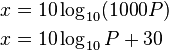
and
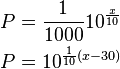
where P is the power in W and x is the power ratio in dBm. Below is a table summarizing useful cases:
| dBm level | Power | Notes |
|---|
| 80 dBm | 100 kW | Typical transmission power of FM radio station with 50-kilometre (31 mi) range |
| 62 dBm | 1.5 kW = 1,500 W | Maximum legal power output of a U.S. ham radio station.[3] |
| 60 dBm | 1 kW = 1,000 W | Typical combined radiated RF power of microwave oven elements |
| 50 dBm | 100 W | Typical thermal radiation emitted by a human body
Typical maximum output RF power from a ham radio HF transceiver |
| 40 dBm | 10 W | Typical PLC (Power Line Carrier) transmit power |
| 37 dBm | 5 W | Typical maximum output RF power from a handheld ham radio VHF/UHF transceiver |
| 36 dBm | 4 W | Typical maximum output power for a Citizens' band radio station (27 MHz) in many countries |
| 33 dBm | 2 W | Maximum output from a UMTS/3G mobile phone (Power class 1 mobiles)
Maximum output from a GSM850/900 mobile phone
|
| 30 dBm | 1 W = 1,000 mW | Typical RF leakage from a microwave oven
DCS or GSM 1,800/1,900 MHz mobile phone. EIRP IEEE 802.11a (20 MHz-wide channels) in either 5 GHz Subband 2 (5,470–5,725 MHz) provided that transmitters are also IEEE 802.11h-compliant, or U-NII-3 (5,725–5,825 MHz). The former is EU only, the latter is US only. |
| 29 dBm | 794 mW | |
| 28 dBm | 631 mW | |
| 27 dBm | 500 mW | Typical cellular phone transmission power
Maximum output from a UMTS/3G mobile phone (Power class 2 mobiles)
|
| 26 dBm | 400 mW | |
| 25 dBm | 316 mW |
| 24 dBm | 251 mW | Maximum output from a UMTS/3G mobile phone (Power class 3 mobiles)
1,880–1,900 MHz DECT (250 mW per 1,728 kHz channel). EIRP for Wireless LAN IEEE 802.11a (20 MHz-wide channels) in either the 5 GHz Subband 1 (5,180–5,320 MHz) or U-NII-2 & -W ranges (5,250–5,350 MHz & 5,470–5,725 MHz respectively). The former is EU only, the latter is US only. |
| 23 dBm | 200 mW | EIRP for IEEE 802.11n Wireless LAN 40 MHz-wide (5 mW/MHz) channels in 5 GHz subband 4 (5,735–5,835 MHz, US only) or 5 GHz subband 2 (5,470–5,725 MHz, EU only). Also applies to 20 MHz-wide (10 mW/MHz) IEEE 802.11a Wireless LAN in 5 GHz Subband 1 (5,180–5,320 MHz) if also IEEE 802.11h compliant (otherwise only 3 mW/MHz → 60 mW when unable to dynamically adjust transmission power, and only 1.5 mW/MHz → 30 mW when a transmitter also cannot dynamically select frequency). |
| 22 dBm | 158 mW |
| 21 dBm | 125 mW | Maximum output from a UMTS/3G mobile phone (Power class 4 mobiles) |
| 20 dBm | 100 mW | EIRP for IEEE 802.11b/g Wireless LAN 20 MHz-wide channels in the 2.4 GHz ISM band (5 mW/MHz).
|
| 19 dBm | 79 mW | |
| 18 dBm | 63 mW | |
| 17 dBm | 50 mW | |
| 15 dBm | 32 mW | Typical Wireless LAN transmission power in laptops. |
| 10 dBm | 10 mW |
| 6 dBm | 4.0 mW |
| 5 dBm | 3.2 mW |
| 4 dBm | 2.5 mW | Bluetooth Class 2 radio, 10 m range |
| 3 dBm | 2.0 mW | More precisely (to 8 decimal places) 1.9952623 mW |
| 2 dBm | 1.6 mW |
| 1 dBm | 1.3 mW |
| 0 dBm | 1.0 mW = 1,000 µW | Bluetooth standard (Class 3) radio, 1 m range |
| −1 dBm | 794 µW |
| −3 dBm | 501 µW |
| −5 dBm | 316 µW |
| −10 dBm | 100 µW | Typical maximum received signal power (−10 to −30 dBm) of wireless network |
| −20 dBm | 10 µW |
| −30 dBm | 1.0 µW = 1,000 nW |
| −40 dBm | 100 nW |
| −50 dBm | 10 nW |
| −60 dBm | 1.0 nW = 1,000 pW | The Earth receives one nanowatt per square metre from a magnitude +3.5 star[5] |
| −70 dBm | 100 pW |
| −73 dBm | 50.12 pW | "S9" signal strength, a strong signal, on the S-meter of a typical ham or shortwave radio receiver |
| −80 dBm | 10 pW | Typical range (−70 to −90 dBm) of wireless received signal power over a network (802.11 variants) |
| −100 dBm | 0.1 pW |
| −111 dBm | 0.008 pW = 8 fW | Thermal noise floor for commercial GPS single channel signal bandwidth (2 MHz) |
| −127.5 dBm | 0.178 fW = 178 aW | Typical received signal power from a GPS satellite |
| −174 dBm | 0.004 aW = 4 zW | Thermal noise floor for 1 Hz bandwidth at room temperature (20 °C) |
| −192.5 dBm | 0.056 zW= 56 yW | Thermal noise floor for 1 Hz bandwidth in outer space (4 kelvins) |
| −∞ dBm | 0 W | Zero power is not well-expressed in dBm (value is negative infinity) |
The signal intensity (power per unit area) can be converted to received signal power by multiplying by the square of the wavelength and dividing by 4π (see
Free-space path loss).
In audio, 0 dBm often corresponds to approximately 0.775 Volts, since 0.775 Volts dissipates 1 mW in a 600 Ω load.
[6] dBu measures against this reference voltage without the 600 Ω restriction.
The dBm is not a part of the
International System of Units and therefore is discouraged from use in documents or systems that adhere to SI units (the corresponding SI unit is the watt). However the straight
decibel (dB), being a unitless ratio of two numbers, is perfectly acceptable.
[7]
Expression in dBm is typically used for optical and electrical power measurements, not for other types of power (such as thermal). A
listing by power levels in watts is available that includes a variety of examples not necessarily related to electrical or optical power.
The dBm was first proposed as an industry standard
[6] in the paper "A New Standard Volume Indicator and Reference Level".
[8]
[edit]See also
[edit]References
[edit]External links


 This article incorporates